Skip to content

The whole product.
On your infrastructure.

Run the Sluis console, Sluis Workspace and gateway on your own Kubernetes or Docker. Air-gapped if you need it, with local models if you want them.

One appliance.
Inside your network.

The same images as the cloud, configured for one tenant. Your people sign in with your identity provider, and you decide whether anything reaches the internet.

Your people and apps

Console, Workspace and API clients, signed in through your OpenID Connect provider.

Your network

Sluis Edge

Inside your infrastructure

Serving
Postgres and pgvectorAudit chainSigned licence
Model trafficApproved provideror local model

Permitted model requests go straight from the appliance to the providers you approve. They do not pass through the Sluis cloud. Use local models to keep them inside your network.

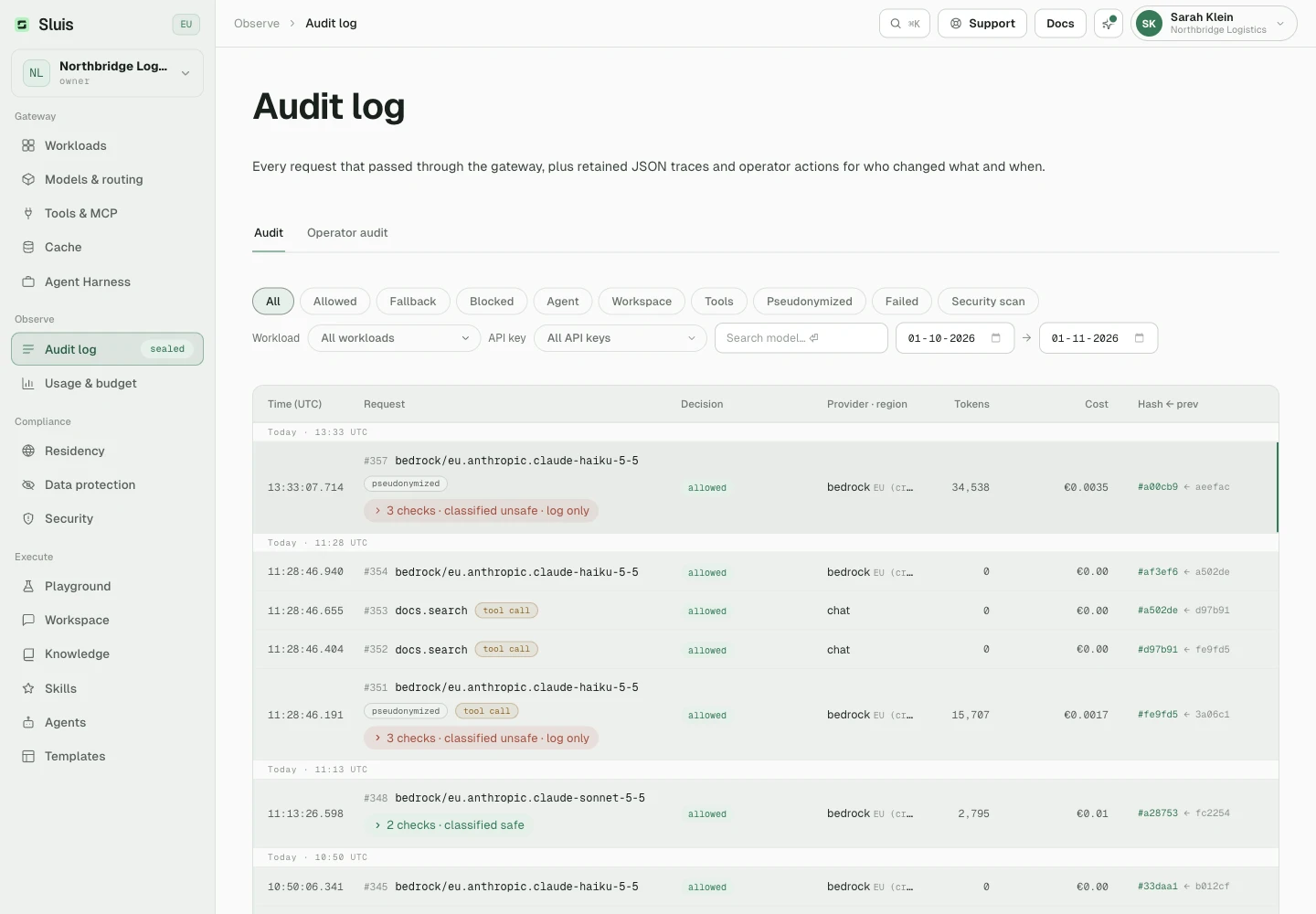
Audit log: inspect sealed requests and their gate decisions.

Your gateway.
Layer by layer.

The whole product runs in your environment. Scroll through what stays with you, what can leave and what keeps working.

Your infrastructureSluis Edge
InspectData protection
RouteModel & tool policy
RecordAudit & usage
Provider keys · token mappings · your database

The same controls, running on your infrastructure.

Inspect locally.

Data protection runs inside your deployment, next to the gateway. Provider credentials and token mappings stay in your database.

Detection is not a guarantee that every sensitive value is found. Review the controls for your data.

Review detection controls

Route where you decide.

Permitted model requests go from your appliance to the providers you approve, or to local models you import. They do not pass through the Sluis cloud.


Models are imported from files you bring in. Nothing is pulled at run time.

Explore the data flow

Keep the record.

Your installation holds the audit chain, the usage ledger and retained content in your own Postgres and object storage.

Back up the database and the secrets. A restore needs the same master and audit keys.

Explore the audit evidence

Keep it licensed.

The licence is a signed file the gateway checks against keys built into it. Renewal means replacing the file and its signature; nothing restarts.

After expiry and a grace period, model calls stop. Sign-in, export and reads keep working and nothing is deleted.

Plan your deployment

AI for teams with real responsibilities.

Talk about your team
Ministerie van Justitie
Omgevingsdienst de Vallei
DCMR Milieudienst Rijnmond
Omgevingsdienst Groene Metropool
Omgevingsdienst Utrecht (ODU)
Omgevingsdienst Midden-West-Brabant
RDW
Adjust
Universiteit van Amsterdam
NHA
Moco Museum
Chemgas
InShared
Het Oranje Kruis
Storteboom
Hyva
Arbeid.ai
Kleentec
Rho Adviseurs
Bezwaarschriftenadviescommissie (BAC)
SoundAware
DLV Advies
Star-shl
Stratego
Contakt
NeKo Ship Supply
Hulshoff
Logisnext / Mitsubishi Forklift Trucks
Bloem Infra
Loendersloot Group
Procap
Condor
Hoogheemraadschap van Rijnland
Aegir Marine
VO-raad & PO-raad
Weekamp Deuren
DBF
STL
Voetbal International
Sena
Move Beyond
Farmplus
Woonbedrijf
Boekenbalie
Medicinfo
Kwast Wijnkopers
Royal ZON
Verhoeven
ABN AMRO
BASF
Bayer
Eurocross
Gilead Sciences
Edelman
PXR
Avanti
Wim Hof Method
Nictiz
Nétive VMS

Cloud or Edge?
Start with the requirement.

Both use the same controls. Your operating model and infrastructure requirements decide where the product belongs.

Managed cloud

Sluis Edge

Runs on

Managed EU infrastructure

Your Kubernetes or Docker

Operations

Managed by Sluis

Your team, release by release

Model traffic

Through the Sluis gateway

From your appliance to approved providers or local models

Audit & retained content

Managed storage

Your Postgres and object storage

Pricing

Usage-based

Flat annual licence per installation

A few useful answers.

Does Edge keep all model traffic inside our network?

Only with local models. With an external model provider, the appliance sends permitted requests directly to that provider, without passing through the Sluis cloud.

Can it run without internet access?

Yes. Air-gapped mode is a supported setup. The gateway refuses to start while an outbound feature is configured, and images and model files come in on your own media or registry.

What do we run it on?

Kubernetes 1.27 or newer with the Helm chart, or Docker Engine on Linux with the Compose bundle. On Windows it runs as Linux in WSL2; there is no native Windows server. It includes Postgres with pgvector, Valkey, object storage and ClamAV. Local models are optional.

How do people sign in?

With your OpenID Connect provider, such as Entra, Keycloak or Okta. Google and Microsoft sign-in are outbound features and are refused when you run air-gapped.

How is Edge licensed?

A flat annual licence per installation, delivered as a signed file. It is not billed by usage. Contact the team to scope your deployment and pricing.

Make the deployment fit your policy.

Bring your infrastructure requirements. We’ll map the data flow with you.

Talk about Edge